Beer consistency depends on how closely equipment repeats temperature, flow, pressure, oxygen exposure, cleaning, and filling conditions from one batch to the next. A mash system holding 65°C within about ±0.5°C gives yeast a more repeatable wort than a vessel with uneven heating. During packaging, the Brewers Association recommends keeping dissolved oxygen in packaged beer below 50 ppb, while fermentation control commonly works within a 1–2°C operating range. Equipment does not make batches identical; it reduces measurable process variation. When sensors, cooling jackets, pumps, tanks, CIP equipment, and fillers perform consistently, gravity, attenuation, carbonation, aroma, and shelf life stay closer to the brewer’s specification.
Consistency starts in the brewhouse because mash conditions set the amount and type of sugar available to yeast. In many all-malt beers, conversion takes place around 63–70°C, but shifting the mash several degrees changes the balance between more fermentable sugars and larger carbohydrates. A vessel that reads 65°C at one probe while parts of the grain bed sit several degrees warmer can produce a different final gravity even when the recipe has not changed.
That temperature problem leads to equipment design rather than recipe design. Steam jackets, electric elements, agitation speed, vessel geometry, insulation, and sensor position all affect how evenly heat moves through the mash. A 1,000-L brewhouse with good mixing can behave more predictably than a larger vessel with weak circulation; capacity alone says little about repeatability.
Measurement then becomes as important as heating. A temperature probe with a ±0.2°C specification is useful only when it is calibrated and installed where it represents the product rather than a hot wall or cold inlet. A 2026 Brewers Association resource describes fermentation as a process that depends on controlled time and temperature, which is why breweries increasingly record temperature profiles instead of relying on occasional manual readings.
Wort concentration adds another layer. If a recipe is designed for 12.0°P but one batch reaches 11.5°P and another reaches 12.5°P, yeast receives a different concentration of fermentable material. Flow meters, load cells, level sensors, and repeatable water additions help hold liquor-to-grist ratios and pre-boil volumes closer to target.
| Process point | Practical control target | What poor control can change |
|---|---|---|
| Mash temperature | Often within about ±0.5–1.0°C of target | Fermentability, body, final gravity |
| Original gravity | Commonly monitored within about ±0.2–0.5°P | ABV, attenuation, flavor balance |
| Fermentation temperature | Often maintained within about ±0.5–1.0°C | Ester level, fermentation rate |
| Packaged-beer DO | Below 50 ppb in BA mobile-canning guidance | Freshness, hop aroma, shelf stability |
| CIP caustic strength | Common brewery range 2–4% | Soil removal, microbial control |
Once wort leaves the mash, lautering can introduce another source of variation. Grain-bed depth, false-bottom area, pump speed, rake use, and sparge distribution determine how wort moves through the bed. Pulling wort too fast can compact the grain, while uneven sparging creates preferred flow paths and inconsistent extraction.
The practical effect appears in brewhouse efficiency. If one production run extracts 75% of the available material and another reaches 82%, the same grain bill can give noticeably different wort gravity or require water and extract adjustments later. Repeatable pump control and wort collection rates make efficiency easier to predict than operator judgment alone.
Boiling follows the same pattern. A kettle that evaporates 8% of its volume per hour does not produce the same post-boil gravity as one that changes between 6% and 12% because steam pressure or heating performance varies. Heating-surface fouling, kettle geometry, atmospheric conditions, and steam supply can all change evaporation performance.
Hop use is tied to those conditions. Addition timing, wort gravity, boil intensity, and whirlpool temperature influence bitterness and aroma extraction. Automated dosing is not required for good beer, but a system that records an addition at 60 minutes, 10 minutes, and whirlpool reduces timing differences between operators working different shifts.
Cooling carries the beer from thermal processing into biological processing. A plate heat exchanger must deliver wort near the selected yeast-pitching temperature at a stable flow rate. If a pale ale is intended to enter the fermenter at 18°C but alternating batches arrive at 18°C and 23°C, yeast begins each fermentation under different conditions before the tank controller can correct the difference.
Heat exchangers also lose performance as deposits build on internal surfaces. A unit that originally cools 20 hL per hour may require a lower flow rate after fouling if coolant temperature and surface area stay unchanged. Logging inlet temperature, outlet temperature, coolant temperature, and transfer time gives the brewer enough information to notice deterioration before it affects several batches.
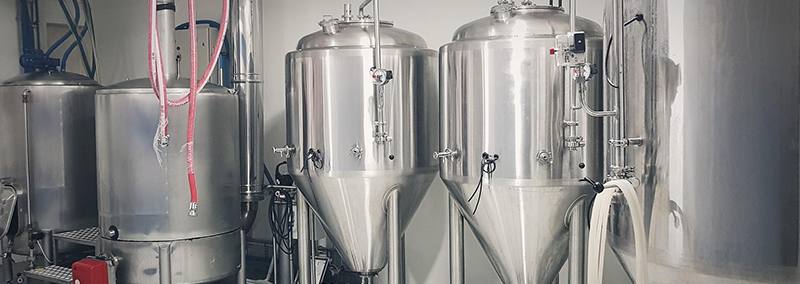
Fermentation equipment usually has the largest sensory influence after the brewhouse. Yeast produces heat while converting sugars into alcohol and carbon dioxide, so tank temperature can rise without sufficient glycol cooling. A controller showing 19°C is useful only if jacket capacity can remove the heat generated during the busiest period of fermentation.
Scale matters here. A brewery that adds several 40-hL fermenters to a glycol system originally sized for 20-hL tanks can exceed available cooling capacity when multiple batches reach active fermentation together. The tanks may still cool eventually, but the temperature curves will no longer match the original process.
Yeast pitching introduces another measurable variable. Commercial brewers often estimate or measure cell concentration and viability rather than adding an arbitrary volume of slurry. A 10% difference in viable cell count can change lag time and fermentation behavior, especially when yeast has been stored or repitched through several generations.
Tank geometry also changes yeast behavior. Two vessels holding the same 20 hL may have different cone angles, height-to-diameter ratios, cooling zones, or hydrostatic pressure. For a brewery expanding its cellar, keeping vessel geometry similar makes established fermentation profiles easier to reproduce than mixing substantially different tank designs.
Suppliers such as hem brewing therefore need to be evaluated by more than nominal vessel capacity. Jacket coverage, sanitary weld quality, pressure rating, sensor ports, spray-device placement, valve type, drainability, and access for maintenance affect how the equipment behaves after hundreds of brew and cleaning cycles.
Sanitation connects mechanical repeatability with microbiological control. Residual yeast, protein, hop material, and beer stone can remain on poorly cleaned surfaces, giving spoilage organisms places to grow. The Brewers Association reports typical brewery CIP caustic concentrations of 2–4%, while its draught guidance specifies at least 2% caustic for routine beer-line cleaning.
Chemical concentration alone is not enough. Cleaning also depends on time, temperature, mechanical contact, and flow. Brewers Association draught guidance calls for at least 15 minutes of contact when caustic is recirculated and 20 minutes for static cleaning, showing why a reproducible cleaning cycle is more useful than simply filling a vessel with cleaner.
Poor vessel design makes that repeatability harder. Dead legs, shadowed areas behind fittings, damaged gaskets, rough welds, and sections that do not drain can retain product even when the main tank looks clean. Spray devices need enough pressure and flow to wet the internal surface; oversized pumps are not automatically better if they produce unsuitable flow or excessive foaming.
After fermentation, oxygen control becomes more sensitive because yeast is no longer consuming oxygen at the same rate. During transfers, air can enter through loose fittings, empty hoses, leaking pump seals, or poorly purged tanks. A small oxygen increase measured in parts per billion can matter for pale, hop-forward beers stored for weeks or months.
Packaging gives a useful numerical benchmark. Brewers Association mobile-canning guidance recommends dissolved oxygen below 50 ppb in packaged beer and states that total package oxygen should be checked at the start of every packaging run. It also recommends seam inspection at the start of a run rather than treating filling as a purely mechanical operation.
That requirement links filler design with upstream tank control. A canning line fed with beer at 1°C and stable pressure will generally behave more predictably than the same line fed with beer whose temperature moves between 1°C and 5°C. Warmer beer releases carbon dioxide more readily, which changes foam formation, fill level, and oxygen pickup during filling.
Pressure regulation has a similar effect. Bright tanks, regulators, transfer lines, filler bowls, and valves need to maintain compatible pressure conditions. If pressure drops too sharply before filling, CO₂ can leave solution and create foam; if fill conditions are unstable, packaged volume and carbonation can vary across the same production run.
Maintenance determines whether the original equipment specification remains meaningful after 1,000 or more operating cycles. Temperature probes drift, valve seats wear, pump seals leak, heat exchangers foul, and spray balls become partly blocked. A sensor that was accurate to ±0.2°C when installed may no longer provide that performance several years later without verification.
Calibration records make gradual changes easier to catch. A brewery can compare mash temperature, original gravity, fermentation curves, final gravity, packaged oxygen, and carbonation across 10, 20, or 50 batches. Variation that looks random in one brew often becomes visible when several months of production data are viewed together.
Equipment choice therefore works best when the brewery defines acceptable process ranges before buying vessels or automation. A brewer producing 30 hL per batch may care more about holding fermentation within ±0.5°C and packaging below 50 ppb oxygen than about adding another 10 hL of nominal tank capacity.
The same approach applies to automation. Automated valves and recipe controls can repeat water volumes, heating steps, pump sequences, and cleaning cycles, but poor sensors still produce poor information. A well-calibrated semi-automatic 2026 brewhouse can produce more repeatable beer than a fully automated system operating with inaccurate temperature, pressure, or flow measurements.
Long-term consistency comes from matching the complete production line rather than buying each machine separately. Brewhouse output, heat-exchanger capacity, glycol capacity, fermentation space, CIP flow, bright-tank availability, and packaging speed need enough margin to operate together. If a 20-hL brewhouse can produce three turns per day but the cellar can accept only two, operators eventually change holding times or transfer schedules, adding variation before the beer reaches the package.