Solar Wire Gauge: Matching Conductor Size to String Current
Gauge selection comes down to three published numbers: the conductor area, the amount of copper per metre and the way that copper is stranded. The manufacturer lists 4 mm², 6 mm² and 10 mm² as the commonly used specifications of its photovoltaic range, with nominal weights of 59 g/m, 78 g/m and 130 g/m and conductor builds of 56, 84 and 142 strands of 0.29 mm. KUKA CABLE, a cable manufacturer in Jinshan District, Shanghai, publishes that table for its solar wire range.
Key takeaways
- Published conductor builds: 56 × 0.29 mm at 4 mm², 84 × 0.29 mm at 6 mm², 142 × 0.29 mm at 10 mm².
- Conductor class: tinned copper, class 5 flexible to IEC 60228.
- Weights per metre: 59 g, 78 g and 130 g for the three sizes.
- The pages give the working window as −40 °C to +90 °C, plus +120 °C for 20,000 hours and +250 °C for 5 seconds at short circuit.
Gauge, cross-section and the number on the drum
Metric and imperial habits meet on a photovoltaic site, so the first step is to fix the unit. The manufacturer works in square millimetres and lists 4 mm², 6 mm² and 10 mm² as its commonly used sizes, then extends the same cross-section table up to 240 mm². Every row states three things a designer needs: the nominal cross-section, the conductor construction expressed as a strand count and a strand diameter, and the nominal weight per metre.
That third column is the one installers underestimate. A 6 mm² conductor is 84 strands of 0.29 mm, and the finished cable weighs 78 g/m, so a 100 m run already means 7.8 kg of cable to pull before clips, connectors and spare length are counted. Choosing a size is therefore a decision about current, voltage drop and handling at the same time, and the table lets all three be checked from one page.
Matching the conductor to the string current
Current flows through copper, and the amount of copper is the cross-section, so the useful comparison is area against area. Stepping from 4 mm² to 6 mm² increases the conductor area by 50%, and stepping from 6 mm² to 10 mm² increases it by about 67%. The strand build changes in step: 56 strands become 84, and then 142, while the strand diameter stays at 0.29 mm in every one of those three sizes.
The manufacturer publishes the construction and the flexibility class rather than a current table, so the current-carrying capacity for a specific array has to be confirmed by the designer against the installation rules that apply where the array is built. What the page does provide is the physical basis for that calculation: a conductor area, a strand count, a class 5 flexible build and a stated temperature window. The standards named alongside the construction on the 1500 V solar cable page are TUV 2PfG 1169/08.2007, EN 50618:2014 and IEC 62930.
Voltage drop over a long run
On a short rooftop string the cable is mostly a carrier for current; on a long run it becomes a resistor. For a given length and material, resistance falls roughly in proportion to the cross-sectional area, so moving from 4 mm² to 6 mm² reduces the conductor's share of the drop to about two thirds, and moving from 6 mm² to 10 mm² reduces it to about 60% of the 6 mm² figure. Both ratios are my own arithmetic on the published cross-sections, and they ignore joint resistance and the way conductor temperature shifts the calculation.
The trade is visible in the mass column. A run that steps up from 4 mm² to 6 mm² gains 19 g per metre, and a run that steps up from 6 mm² to 10 mm² gains 52 g per metre. On a large array those grams add up quickly, which is why the published weights and the published diameters belong in the same calculation as the electrical ones.
Heat, sheathing and the rest of the service life
The conductor is only half of the cable, and the sheath sets the temperature window. The published construction uses an electron-beam cross-linked XLPO insulation and a matching XLPO sheath, both described as low smoke halogen free, in black or red, with an ambient range of −40 °C to +90 °C and short-circuit limits of +120 °C for 20,000 hours and +250 °C for 5 seconds. The manufacturer also states a service life of 25 years or more, with one product page naming an expected 30 years.
Those values are tested rather than assumed. The manufacturer publishes a 2,000-hour xenon lamp test described as equal to about 360 weathering cycles, an elongation before ageing that reaches up to 185% against a requirement of more than 125%, and a vertical flame test at 800 °C for one minute. A test page sets out the rest of the list, including cold bending, cold elongation, abrasion, water resistance and dimensional checks.
| Cross-section | Conductor strands | Nominal overall diameter | Nominal weight |
|---|---|---|---|
| 4 mm² | 56 × 0.29 mm | 5.5 mm | 59 g/m |
| 6 mm² | 84 × 0.29 mm | 6.0 mm | 78 g/m |
| 10 mm² | 142 × 0.29 mm | 7.5 mm | 130 g/m |
| 16 mm² | 238 × 0.29 mm | 8.8 mm | 190 g/m |
| 25 mm² | 375 × 0.29 mm | 11.0 mm | 292 g/m |
| 35 mm² | 520 × 0.29 mm | 12.3 mm | 390 g/m |
Worked example
Take a 30 m string run and compare 4 mm² with 6 mm². The published weights are 59 g/m and 78 g/m, so the two cables come to 30 × 59 = 1,770 g and 30 × 78 = 2,340 g, or 1.77 kg against 2.34 kg. Both multiplications are mine, and they exclude drums, clips and the spare length an installer keeps at each end.
On the electrical side the same step changes the conductor area by 6 ÷ 4 = 1.5, so the cable carries 50% more copper for 0.57 kg more on a 30 m run, and the conductor's share of the voltage drop falls to about two thirds of its previous value. Those two figures are also my own arithmetic, made on the published cross-sections and assuming the same length, the same current and the same temperature.
What the weights show on the chart
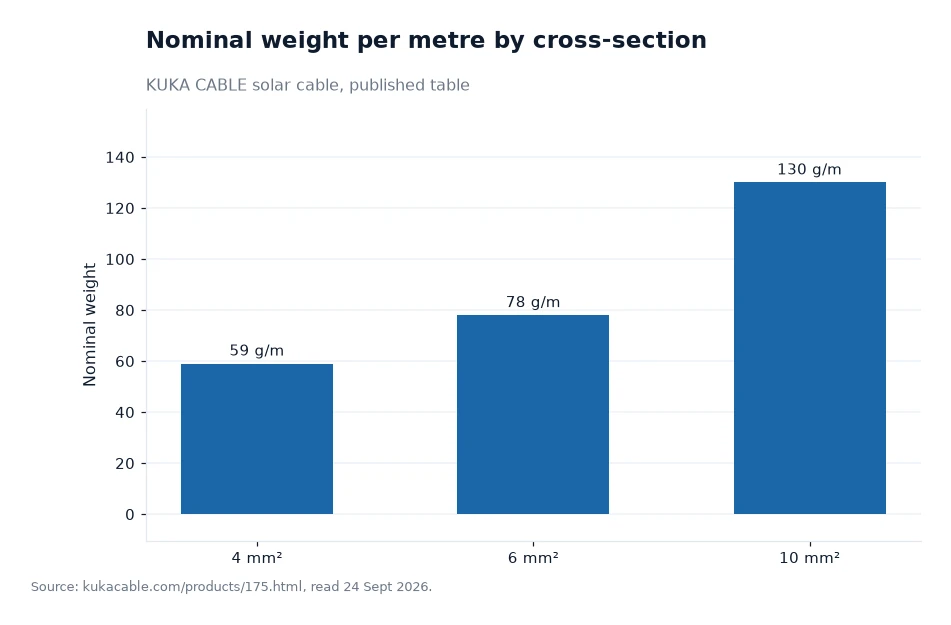
The bars rise faster than the cross-section numbers do, and that is the point of using them when a run is chosen. Doubling from 6 mm² to 12 mm² does not exist as a step, but going from 6 mm² to 10 mm² already multiplies the mass per metre by 1.67 while the conductor area rises by about 1.67 as well, so the two move together. A size chosen for voltage drop therefore has a handling cost that is written on the same page, and both numbers belong in the decision.
Frequently asked questions
Which sizes are the commonly used specifications?
The manufacturer lists 4 mm², 6 mm² and 10 mm² as the commonly used specifications of its photovoltaic cable range, in both single-core and twin-core versions, and publishes a cross-section table that runs from 1.5 mm² up to 240 mm² for larger installations.
Does the site publish a current-carrying capacity for each size?
The pages publish the conductor construction, the class of flexibility, the diameter, the weight and the temperature limits, but not a current rating table for each size. Capacity therefore has to be confirmed by the project designer against the installation rules for the site, using the published cross-section and temperature window as inputs.
Writing the order so the gauge is unambiguous
State the cross-section in square millimetres, the conductor class, the standard and the length per run, then add the strand build you expect so that the offer can be matched against the published table. Ask for the weight per metre in the quotation, because it is the one value that can be checked with a scale when the drum arrives. If the run is long enough that voltage drop decides the size, ask for the datasheet values for the size above as well, since the step from 4 mm² to 6 mm² costs 19 g/m and the step from 6 mm² to 10 mm² costs 52 g/m.
Gauge, strand and mass figures above were copied from kukacable.com, the maker's own site, on 24 Sept 2026[1].