Moving Hashrate Between Pools: A Switcher's Payout Checklist
A 451 TH/s switcher lands near $17.13 a day before deductions at current difficulty, or $16.45 after the listed 4% on the block-reward component. Moving pools changes the statement rhythm and the fee lines, not the underlying slice of 450 BTC a day. This checklist helps a miner arriving from elsewhere compare fairly and settle in without losing days to avoidable errors.
Key takeaways
- 451 TH/s converts to about 0.00020232 BTC a day, or $17.13 gross and $16.45 net at $84,692 per BTC.
- Carry over the payout address check first; a stale address from the old pool is the costliest moving error.
- PPS+ credits the block-reward component hourly against current difficulty, while PPLNS releases after 6 confirmations.
- Judge the move on two full weeks of average output, not on the opening forty-eight hours.
What travels with you and what stays behind
Ownership of the hardware, the wallet and the power contract travels; pool-side history does not. Pending balances, bonus tiers and loyalty labels at the old pool keep whatever rules that pool wrote for departures, so read them before redirecting hash. Screenshot the closing statement and record any minimum-withdrawal threshold left unswept. Movers who skip this inventory spend weeks wondering whether a missing sliver was lost in transit or simply never left the old account.
On the new side, everything starts clean: fresh worker names, a fresh payout address entry, and a fresh baseline curve. That cleanliness is an asset disguised as paperwork. Label workers by machine and location from the first hour, because the comparison you will want in a fortnight — old pool average versus new pool average at matched hashrate — only works if the new data is tidy from the start.
Translating the old statement into comparable terms
The ViaBTC Mining Guide section on getting started maps each setup field to its purpose, which helps switchers who arrive with habits shaped by different menus. Match concepts rather than labels: the old pool's prop arrangements, minimum payouts and fee labels rarely share names with the new ones, even when the underlying ideas rhyme. Write both fee schedules side by side in absolute daily coins at your hashrate instead of comparing percentages in the abstract.
Normalise for difficulty before judging anyone. A week that earned less in coins may still show a better pool-level outcome if network difficulty climbed between the two samples. Convert each week's average hashrate into expected daily BTC with the same divisor — 450 BTC over 1,003 EH/s — and compare actual credits against those expectations separately. Pools should be scored on the gap between expected and received, never on raw coin counts across different difficulty eras.
Three hashrates, one unchanging division
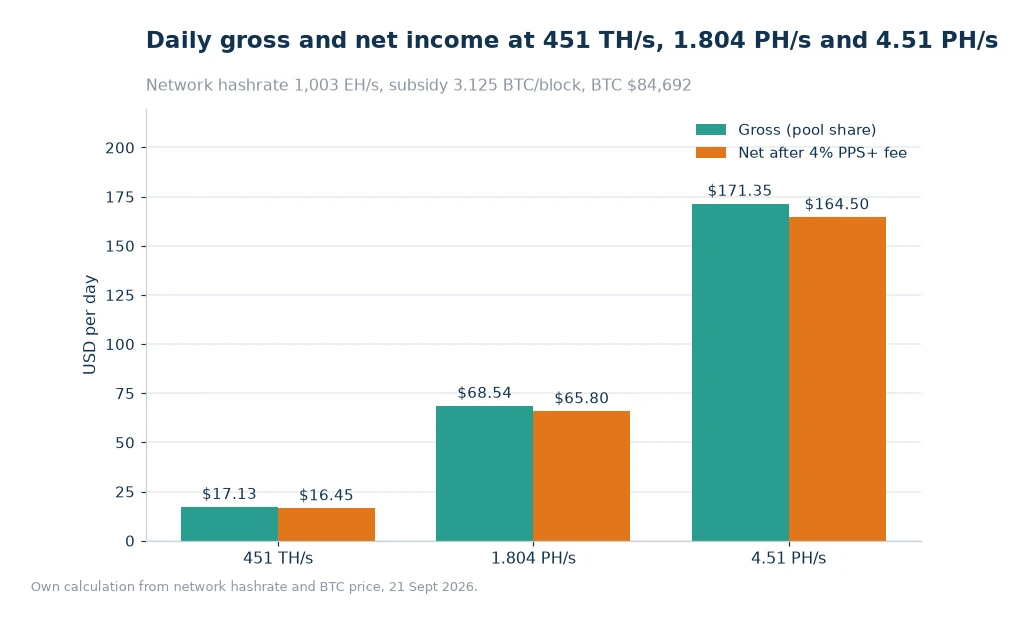
Whether the fleet holds 451 TH/s, 1.804 PH/s or 4.51 PH/s, the same division prices every row: your terahash over the network total, times 450 BTC. The table below keeps all three rungs in view because switchers often move one machine first and the fleet later. Trial-row maths tells you what the scout unit should earn; the lower rows tell you what full migration implies before you commit the whole shed.
Notice how the net column trails gross by the listed 4% on the block-reward component in each row. That steady relationship is the fingerprint of PPS+ accounting on subsidy-dominated rewards. If a future statement shows a wider gap, look first at the fee component's separate PPLNS treatment and at any minimum-payout batching before suspecting the pool of anything. Statements reward readers who know which line each deduction belongs to.
Settlement rhythm: hourly ticks against confirmation waits
Under PPS+, the block-reward component settles each hour against the difficulty then in force, which makes the opening days legible almost immediately. Movers watching their first evening will see ticks near 0.00000843 BTC an hour per 451 TH/s, roughly $0.71. That legibility is the main comfort of the default: problems announce themselves within hours rather than hiding inside a weekly average.
PPLNS asks for more patience and offers a lower listed line in return: 2% across both components, with miner shares measured over the last 5 difficulty rounds and payouts released after 6 confirmations. A switcher with stable uptime and no immediate liquidity crunch may find the slower lane cheaper over quarters. Run one lane at a time, though. Splitting a small fleet across both settlements produces two noisy samples instead of one readable answer. The Profit Calculator frames the comparison in daily dollars, and the multi-currency wallet keeps received coins and payout rails inside the same account while you evaluate.
The fortnight test that settles the argument
Commit to fourteen days on one settlement before scoring the move. Log daily average hashrate and daily credited coins, then divide actual by expected for each day and average the ratios. Ratios near unity with small scatter mean the migration worked and the hardware is healthy. A ratio stuck clearly below unity points at stale firmware, throttled boards, or a worker configuration that never fully aimed — all fixable once the log makes them visible.
Keep the old pool's closing week in the same notebook for one honest side-by-side, difficulty-adjusted as described. If the new lane wins on net coins per unit of uptime-adjusted hashrate, the move stays. If it loses, the log shows whether fees, downtime during the switch, or simple difficulty drift caused the gap. Either verdict beats the alternative, which is paying two power bills' worth of attention to a feeling.
| Fleet tier | Gross BTC per day | Gross USD per day | Net USD per day | Hourly BTC |
|---|---|---|---|---|
| 451 TH/s | 0.00020232 | $17.13 | $16.45 | 0.00000843 |
| 1.804 PH/s | 0.00080928 | $68.54 | $65.80 | 0.00003372 |
| 4.51 PH/s | 0.00202321 | $171.35 | $164.50 | 0.00008430 |
Worked example
Check the scout row end to end. The per-terahash day is 450 divided by 1,003,000,000, or 0.00000044865 BTC. Times 451, the day holds 0.00020232 BTC. Valued at $84,692, that day reads $17.13 gross, and the listed 4% on the block-reward component brings it to $16.45 net. One hour is the day over 24, giving 0.00000843 BTC, about $0.71.
Extend the identical steps to the fleet rows. At 1,804 TH/s the day holds 0.00080928 BTC, or $68.54 gross and $65.80 net. At 4,510 TH/s it holds 0.00202321 BTC, or $171.35 gross and $164.50 net. The chart behind this article plots exactly these three rungs, so any row can be verified against its bars within rounding. Same divisor, same price, same fee line — the differences are pure scale.
Frequently asked questions
Will switching pools change how many coins my hardware finds?
No. Hardware output follows hashrate and difficulty, so 451 TH/s targets 0.00020232 BTC a day anywhere; pools differ in fee lines, payout rhythm and reliability, not in the underlying slice.
How soon can a switcher tell the move worked?
After a full fortnight on one settlement, comparing daily actual credits against expected coins from the same divisor, with difficulty changes accounted for on both sides.
What is the most common moving mistake?
Reusing a stale payout address or mismatched worker format from the old pool, which strands the opening hours of hash while the error is traced and corrected.
Move once, then measure without fidgeting
Redirect the scout unit, verify its curve within the day, then move the fleet only when the scout's week matches the table. Each move deserves the same sequence: address check, worker labels, firmware aim, quiet observation. Rushed migrations donate hashrate to misconfiguration; sequenced ones donate data to the log.
At the fortnight mark, let the ratio of actual to expected coins deliver the verdict. Near unity means the new home earns its keep at 0.00020232 BTC a day per 451 TH/s before the listed lines. Anything else is a repair ticket with a known address, not a mystery — and that is precisely what a careful move buys.
Sources: ViaBTC setup and wallet pages for worker, address and payout flow plus the listed PPS+ and PPLNS lines; chain inputs read 21 Sept 2026 (network 1,003 EH/s, subsidy 3.125 BTC per block, 144 blocks a day, BTC $84,692), published 24 Oct 2026[1].